The third installment of the Twitter files have been released by Matt Taibbi and reveal how high ranking Twitter Executives worked with the FBI, DHS and other government officials, to silence, censor and delete President Donald Trump BEFORE Jan. 6th.
Keep in mind Donald Trump this censorship was taking place in the lead up to the presidential election and boils down to nothing less than election interference as Trump was actively campaigning for re-election.
From the account of @MTaibbi:
THREAD: The Twitter Files THE REMOVAL OF DONALD TRUMP Part One: October 2020-January 6th
The world knows much of the story of what happened between [protests] at the Capitol on January 6th, and the removal of President Donald Trump from Twitter on January 8th…
We’ll show you what hasn’t been revealed: the erosion of standards within the company in months before J6, decisions by high-ranking executives to violate their own policies, and more, against the backdrop of ongoing, documented interaction with federal agencies.
This first installment covers the period before the election through January 6th. Tomorrow, will reveal the secret internal communications from the key date of January 8th.
Whatever your opinion on the decision to remove Trump that day, the internal communications at Twitter between January 6th-January 8th have clear historical import. Even Twitter’s employees understood in the moment it was a landmark moment in the annals of speech.

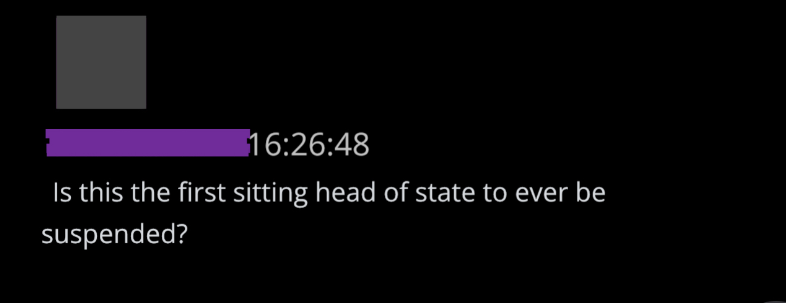
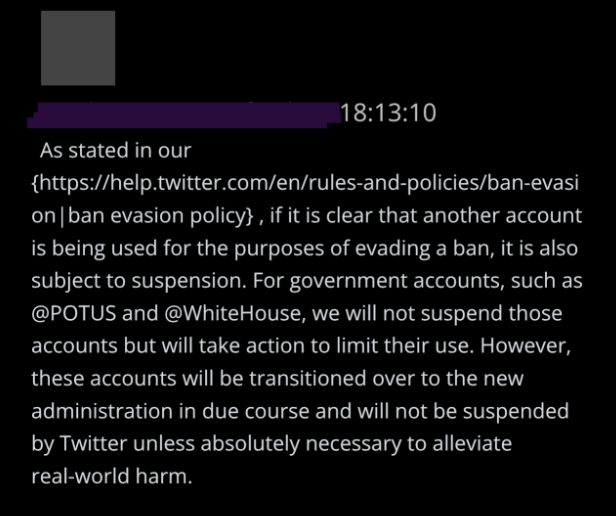
As soon as they finished banning Trump, Twitter execs started processing new power. They prepared to ban future presidents and White Houses – perhaps even Joe Biden. The “new administration,” says one exec, “will not be suspended by Twitter unless absolutely necessary.”
Twitter executives removed Trump in part over what one executive called the “context surrounding”: actions by Trump and supporters “over the course of the election and frankly last 4+ years.” In the end, they looked at a broad picture. But that approach can cut both ways.
The bulk of the internal debate leading to Trump’s ban took place in those three January days. However, the intellectual framework was laid in the months preceding the Capitol [protests]
Before J6, Twitter was a unique mix of automated, rules-based enforcement, and more subjective moderation by senior executives. As reported, the firm had a vast array of tools for manipulating visibility, most all of which were thrown at Trump (and others) pre-J6.
As the election approached, senior executives – perhaps under pressure from federal agencies, with whom they met more as time progressed – increasingly struggled with rules, and began to speak of “vios” as pretexts to do what they’d likely have done anyway.
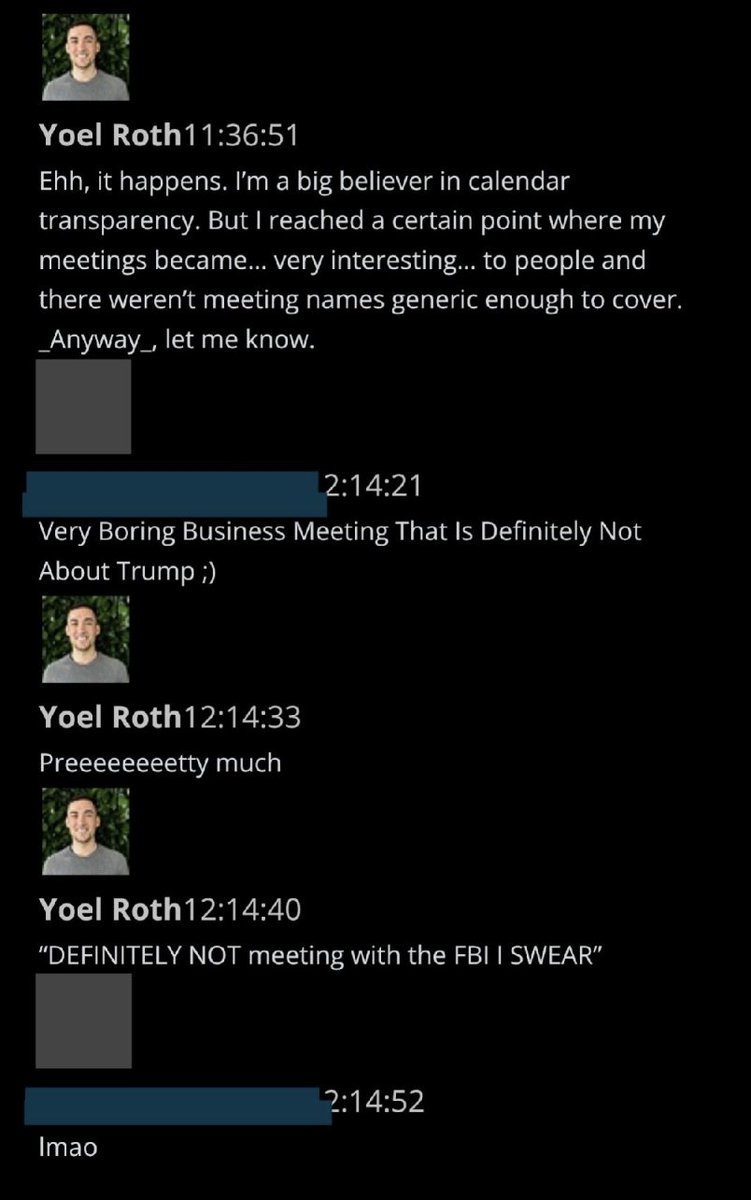
After J6, internal Slacks show Twitter executives getting a kick out of intensified relationships with federal agencies. Here’s Trust and Safety head Yoel Roth, lamenting a lack of “generic enough” calendar descriptions to concealing his “very interesting” meeting partners.
These initial reports are based on searches for docs linked to prominent executives, whose names are already public. They include Roth, former trust and policy chief Vijaya Gadde, and recently plank-walked Deputy General Counsel (and former top FBI lawyer) Jim Baker.
One particular slack channel offers an unique window into the evolving thinking of top officials in late 2020 and early 2021.
On October 8th, 2020, executives opened a channel called “us2020_xfn_enforcement.” Through J6, this would be home for discussions about election-related removals, especially ones that involved “high-profile” accounts (often called “VITs” or “Very Important Tweeters”).
There was at least some tension between Safety Operations – a larger department whose staffers used a more rules-based process for addressing issues like porn, scams, and threats – and a smaller, more powerful cadre of senior policy execs like Roth and Gadde.
The latter group were a high-speed Supreme Court of moderation, issuing content rulings on the fly, often in minutes and based on guesses, gut calls, even Google searches, even in cases involving the President.
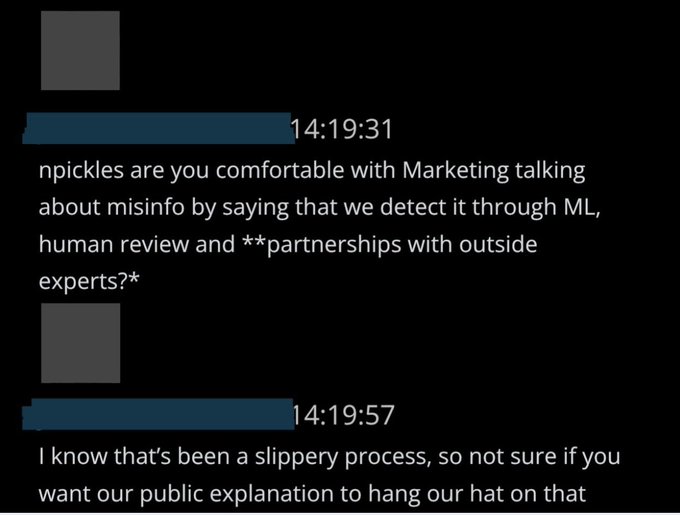
During this time, executives were also clearly liaising with federal enforcement and intelligence agencies about moderation of election-related content. While we’re still at the start of reviewing the #TwitterFiles, we’re finding out more about these interactions every day. Policy Director Nick Pickles is asked if they should say Twitter detects “misinfo” through “ML, human review, and **partnerships with outside experts?*” The employee asks, “I know that’s been a slippery process… not sure if you want our public explanation to hang on that.”
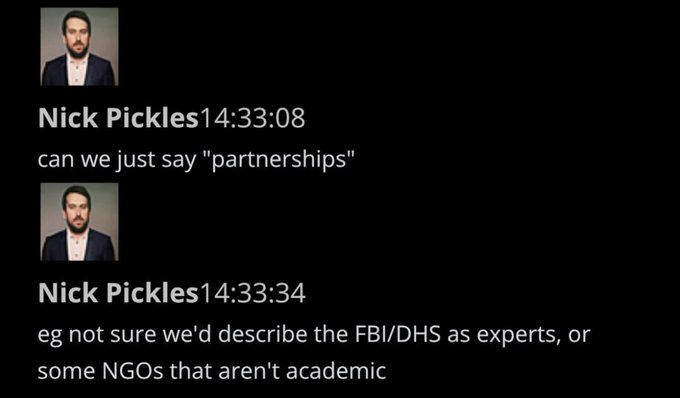
Pickles quickly asks if they could “just say “partnerships.” After a pause, he says, “e.g. not sure we’d describe the FBI/DHS as experts.”
This post about the Hunter Biden laptop situation shows that Roth not only met weekly with the FBI and DHS, but with the Office of the Director of National Intelligence (DNI):
Some of Roth’s later Slacks indicate his weekly confabs with federal law enforcement involved separate meetings. Here, he ghosts the FBI and DHS, respectively, to go first to an “Aspen Institute thing,” then take a call with Apple.
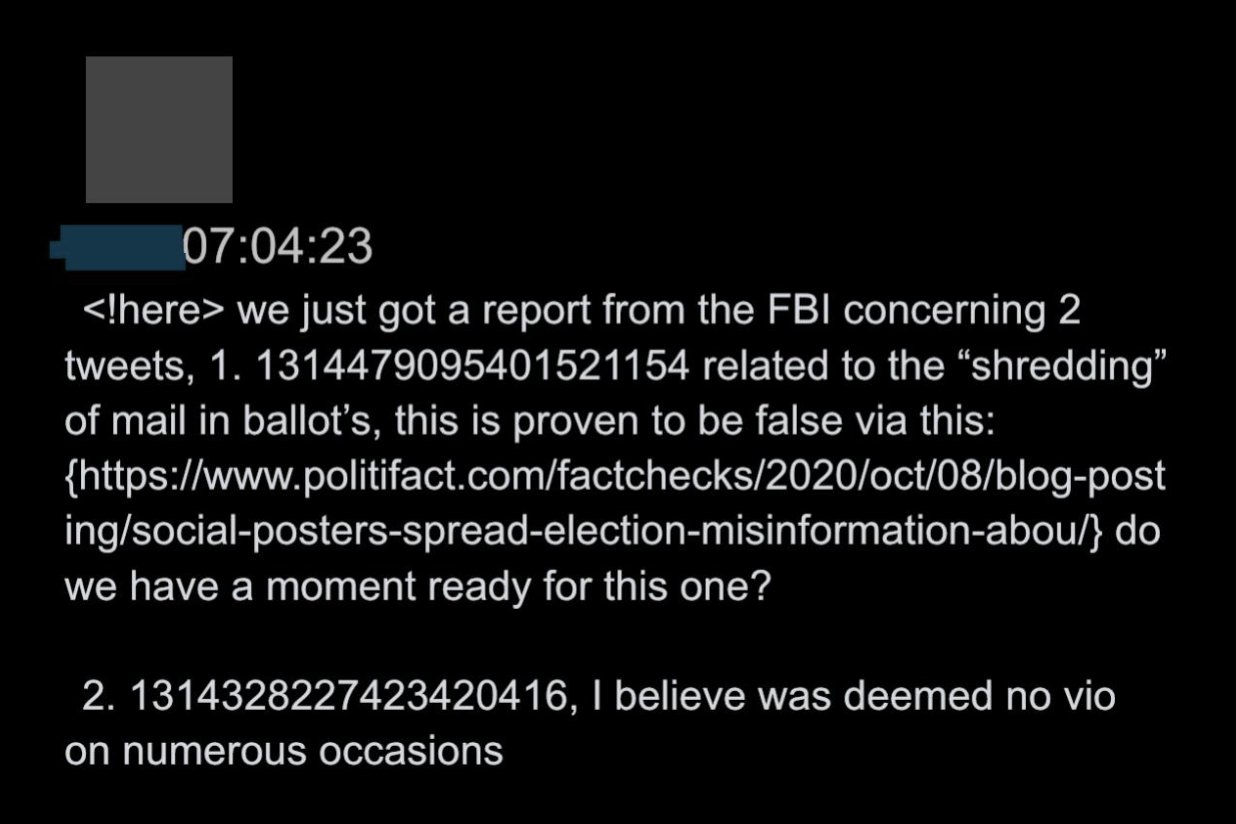
Here, the FBI sends reports about a pair of tweets, the second of which involves a former Tippecanoe County, Indiana Councilor and Republican named claiming “Between 2% and 25% of Ballots by Mail are Being Rejected for Errors.”
The FBI-flagged tweet then got circulated in the enforcement Slack. Twitter cited Politifact to say the first story was “proven to be false,” then noted the second was already deemed “no vio on numerous occasions.”
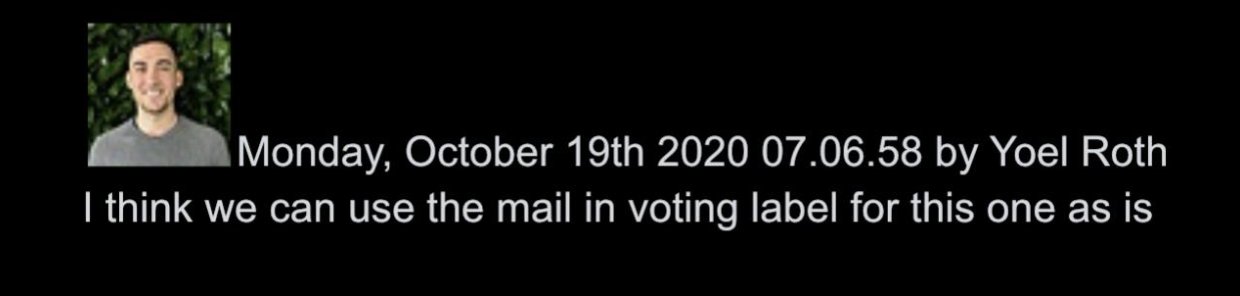
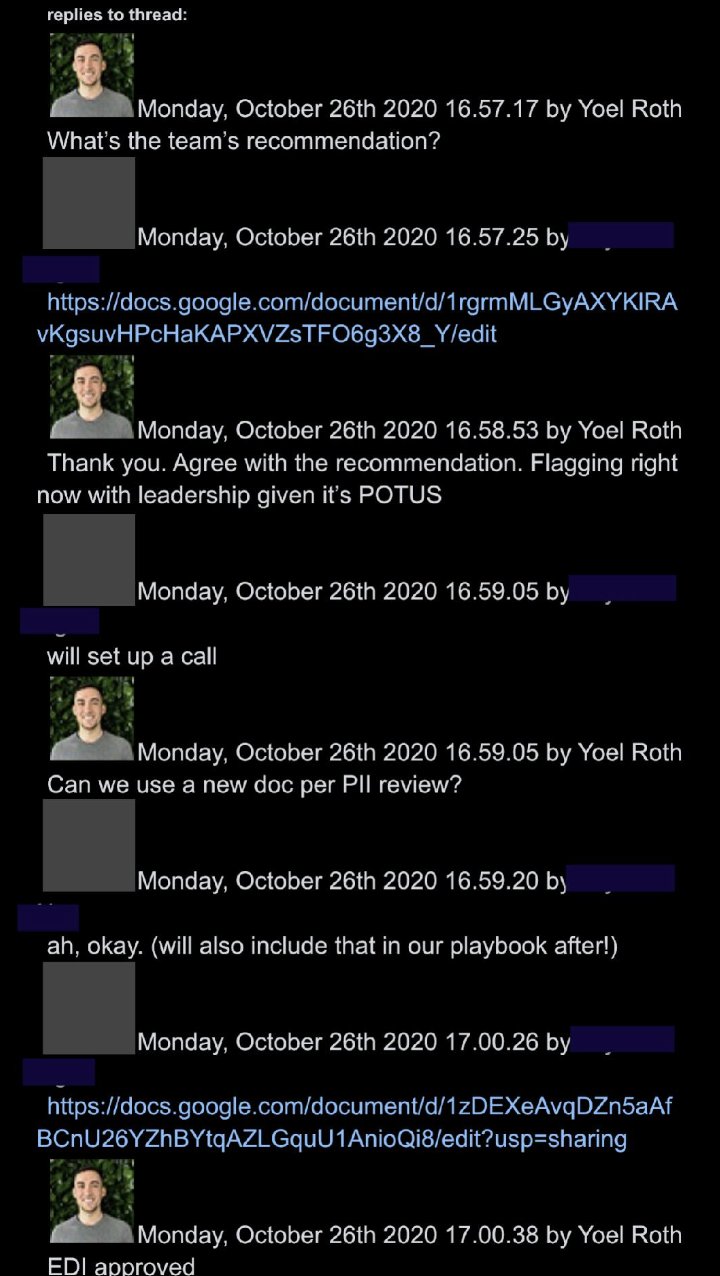
The group then decides to apply a “Learn how voting is safe and secure” label because one commenter says, “it’s totally normal to have a 2% error rate.” Roth then gives the final go-ahead to the process initiated by the FBI:
Examining the entire election enforcement Slack, we didn’t see one reference to moderation requests from the Trump campaign, the Trump White House, or Republicans generally. We looked. They may exist: we were told they do. However, they were absent here.
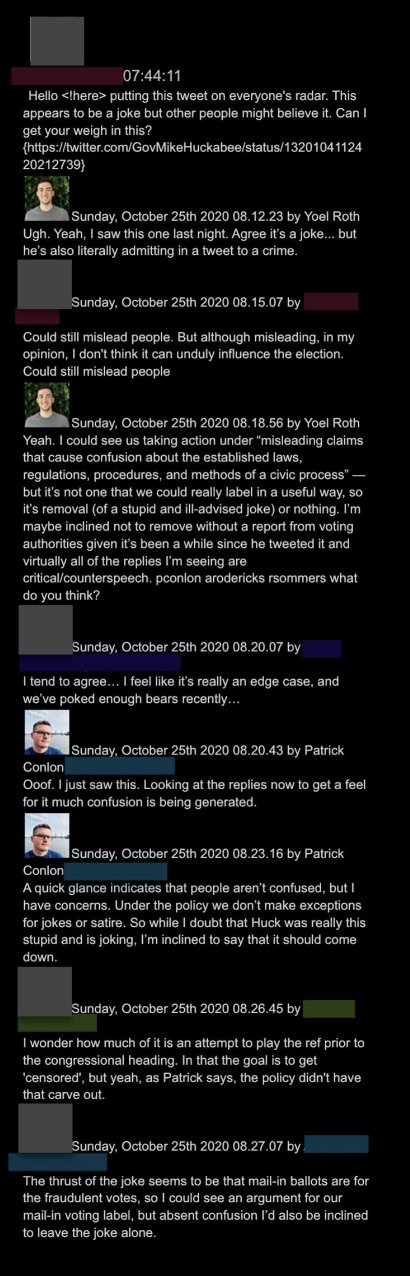
This inspires a long Slack that reads like an parody. “I agree it’s a joke,” concedes a Twitter employee, “but he’s also literally admitting in a tweet a crime.”
“Could still mislead people… could still mislead people,” the humor-averse group declares, before moving on from Huckabee
Roth suggests moderation even in this absurd case could depend on whether or not the joke results in “confusion.” This seemingly silly case actually foreshadows serious later issues:
In the docs, execs often expand criteria to subjective issues like intent (yes, a video is authentic, but why was it shown?), orientation (was a banned tweet shown to condemn, or support?), or reception (did a joke cause “confusion”?). This reflex will become key in J6.
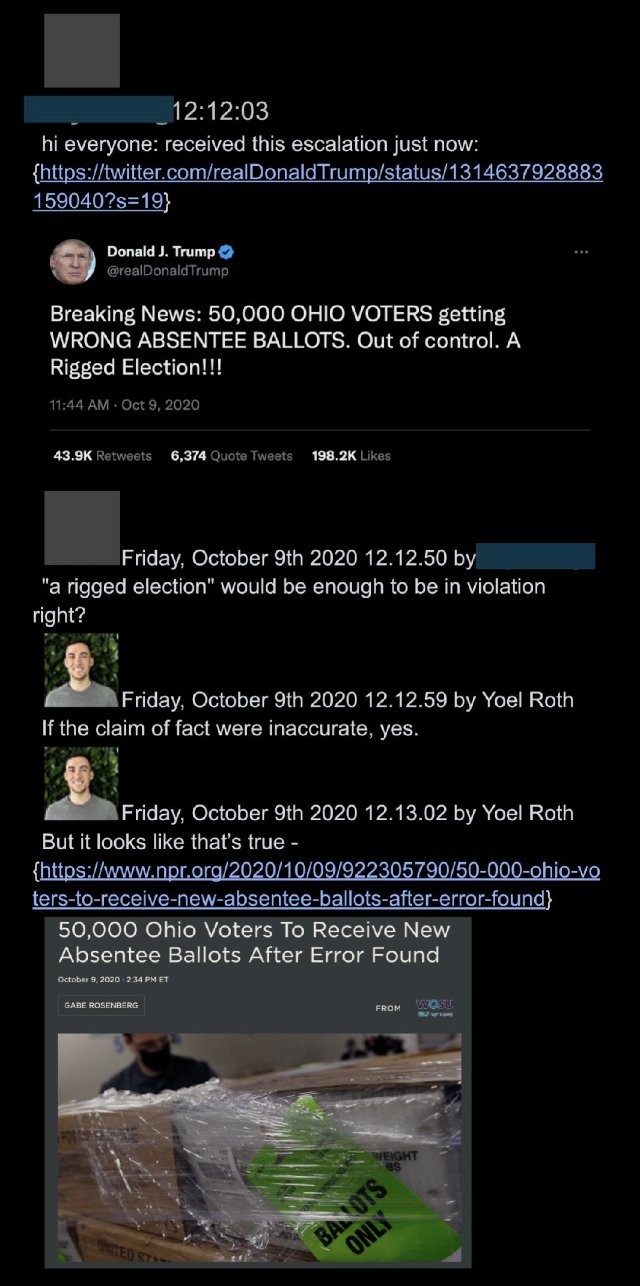
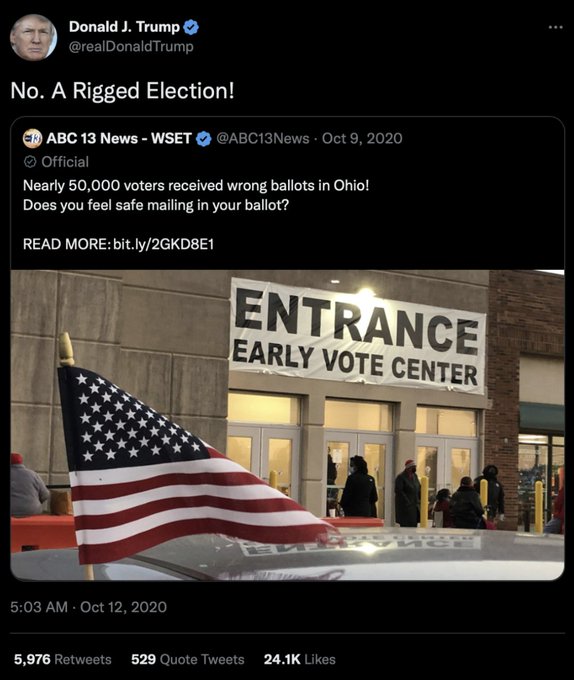
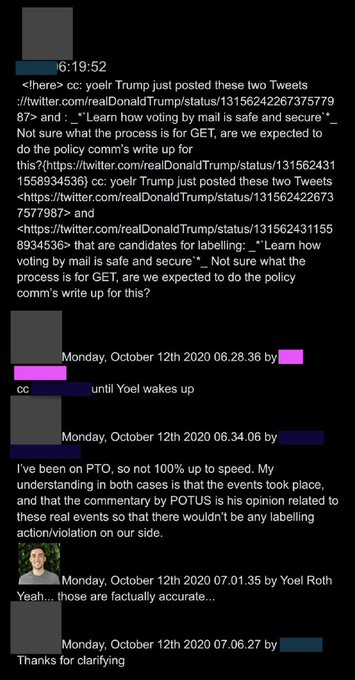
In another example, Twitter employees prepare to slap a “mail-in voting is safe” warning label on a Trump tweet about a postal screwup in Ohio, before realizing “the events took place,” which meant the tweet was “factually accurate”:
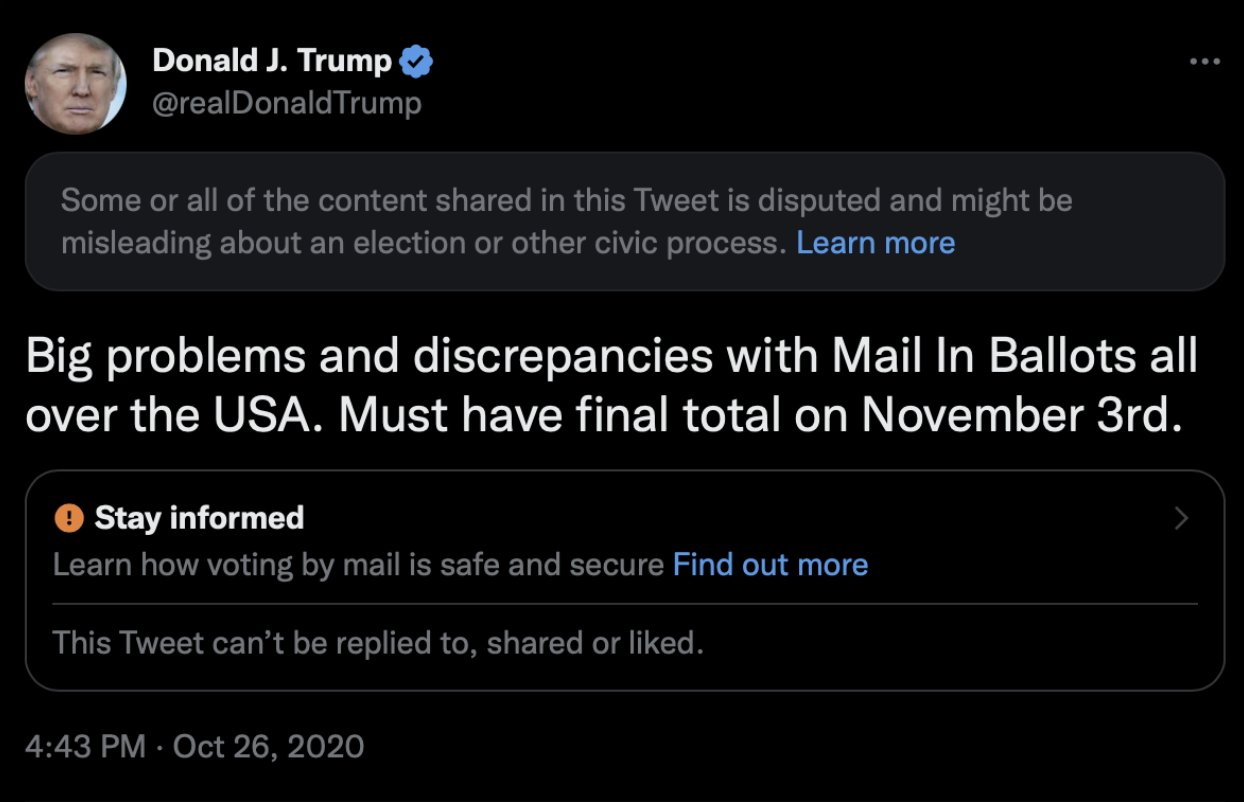
“VERY WELL DONE ON SPEED” Trump was being “visibility filtered” as late as a week before the election. Here, senior execs didn’t appear to have a particular violation, but still worked fast to make sure a fairly anodyne Trump tweet couldn’t be “replied to, shared, or liked”:
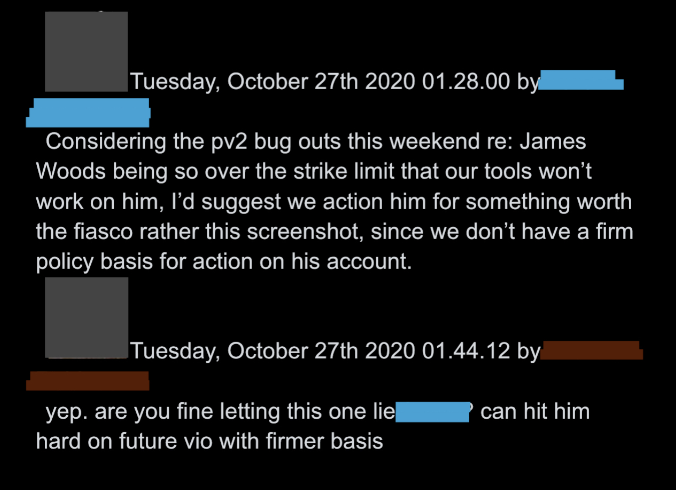
A seemingly innocuous follow-up involved a tweet from actor , whose ubiquitous presence in argued-over Twitter data sets is already a #TwitterFiles in-joke.
After Woods angrily quote-tweeted about Trump’s warning label, Twitter staff – in a preview of what ended up happening after J6 – despaired of a reason for action, but resolved to “hit him hard on future vio.”
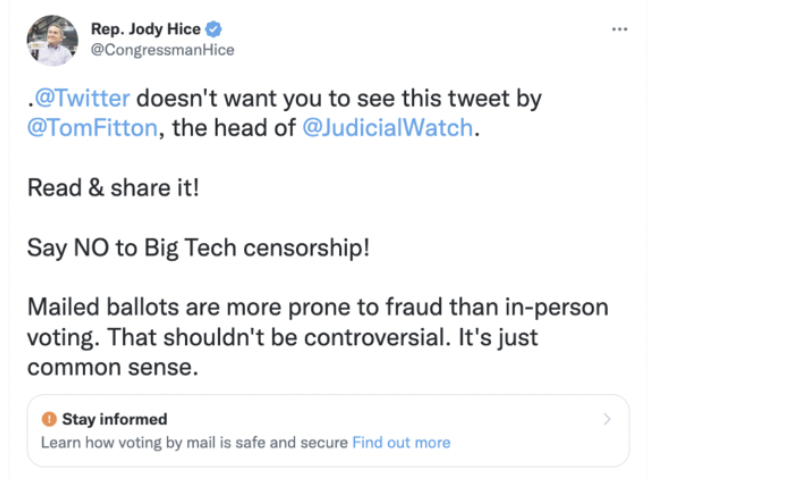
Here a label is applied to Georgia Republican congresswoman Jody Hice for saying, “Say NO to big tech censorship!” and, “Mailed ballots are more prone to fraud than in-person balloting… It’s just common sense.”
Twitter teams went easy on Hice, only applying “soft intervention,” with Roth worrying about a “wah wah censorship” optics backlash:
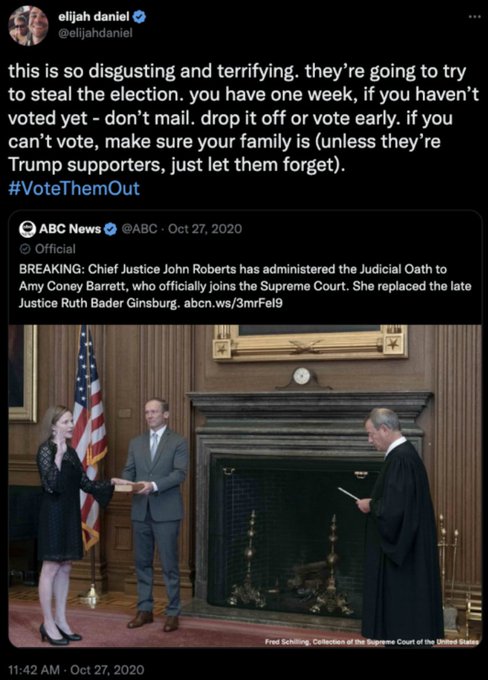
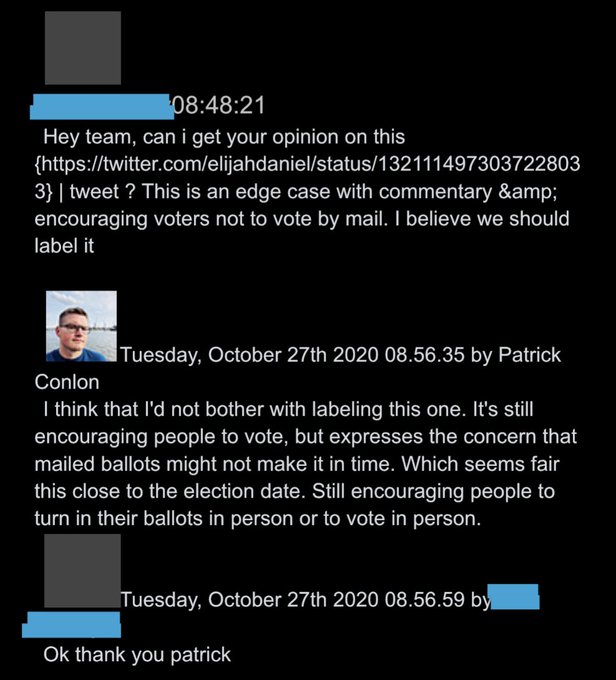
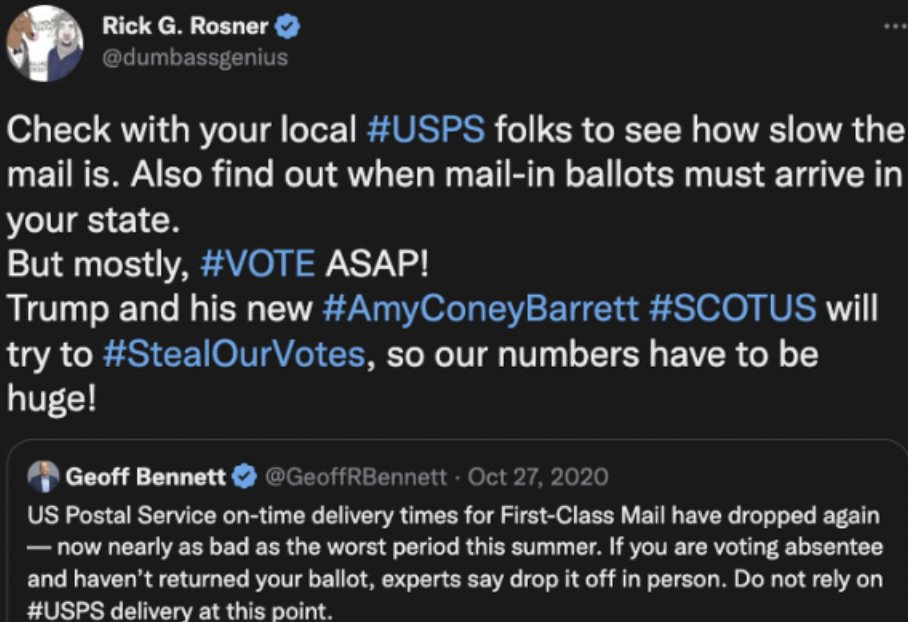
Meanwhile, there are multiple instances of involving pro-Biden tweets warning Trump “may try to steal the election” that got surfaced, only to be approved by senior executives. This one, they decide, just “expresses concern that mailed ballots might not make it on time.”
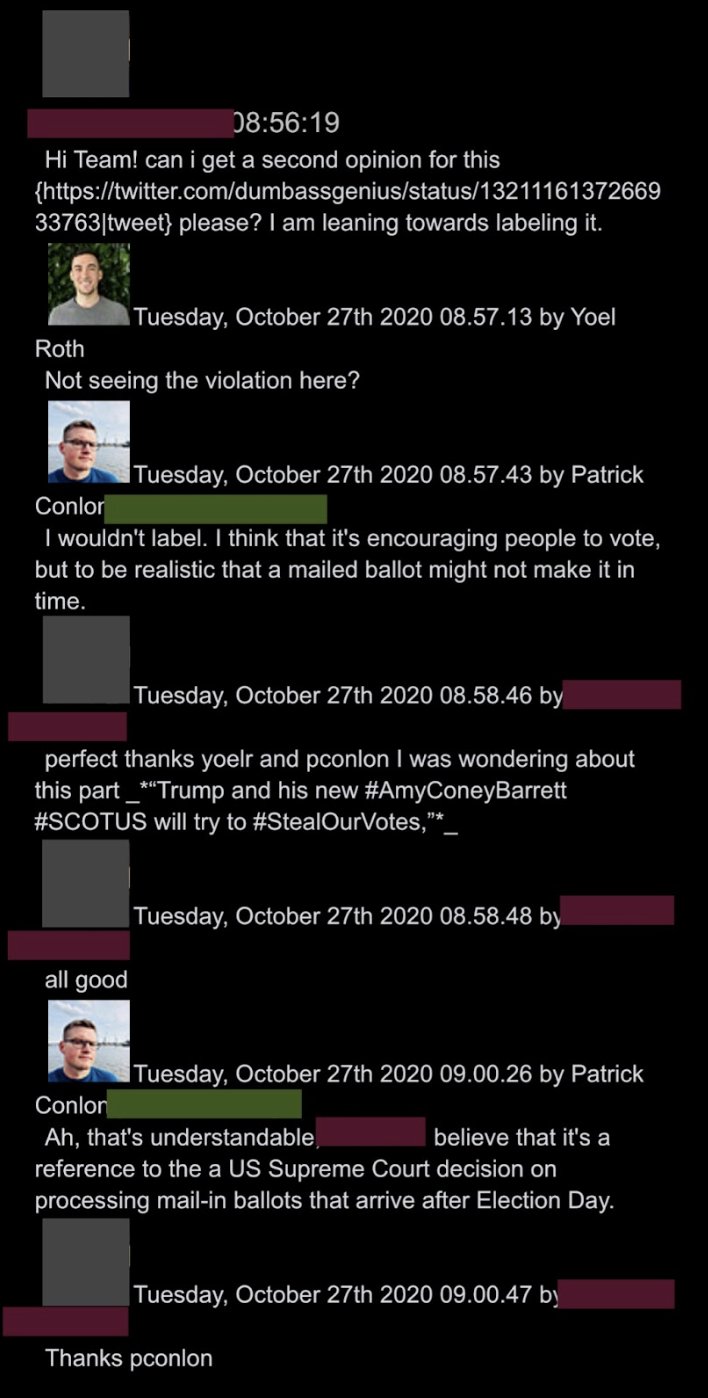
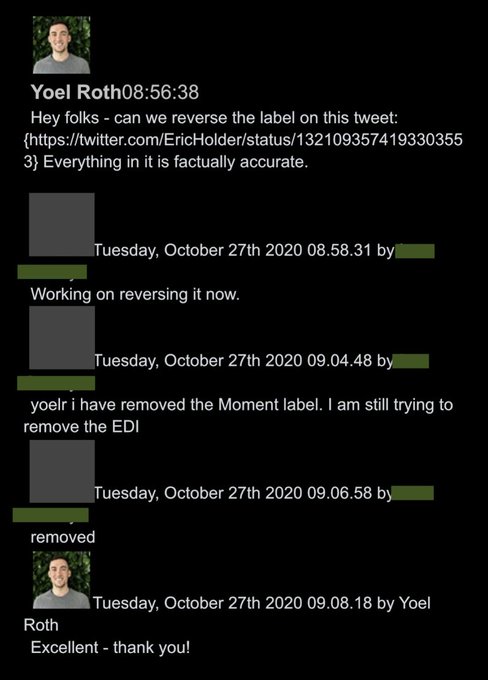
“THAT’S UNDERSTANDABLE”: Even the hashtag #StealOurVotes – referencing a theory that a combo of Amy Coney Barrett and Trump will steal the election – is approved by Twitter brass, because it’s “understandable” and a “reference to… a US Supreme Court decision.” In this exchange, again unintentionally humorous, former Attorney General Eric Holder claimed the U.S. Postal Service was “deliberately crippled,”ostensibly by the Trump administration. He was initially hit with a generic warning label, but it was quickly taken off by Roth:
Later in November 2020, Roth asked if staff had a “debunk moment” on the “SCYTL/Smartmantic vote-counting” stories, which his DHS contacts told him were a combination of “about 47” conspiracy theories:
On December 10th, as Trump was in the middle of firing off 25 tweets saying things like, “A coup is taking place in front of our eyes,” Twitter executives announced a new “L3 deamplification” tool. This step meant a warning label now could also come with deamplification: